
Julian Hill on Multicultural Australia, Migration and the Politics of Division
 नेपालआईज
Australia’s bipartisan multicultural compact, signed off in the 1970s, is under strain. The pressures are not new but increasingly detached from the values that shaped both Labor and Liberal support for the policy of multiculturalism. Populism from the left and right erodes the political centre that sustained the policy and saw it broadly accepted by most Australians for more than 50 years.
Big ‘M’ multiculturalism – where is it?
The pressures are everywhere. Migrants and cultural pluralism remain easy political targets to in times economic strain. There is, however, a new intensity today.
Big ‘M’ multiculturalism, built by Labor and Liberal governments, is at its core about integrating migrants into Australia and helping people from diverse backgrounds become proud Australians. It rests on pluralism, liberal democracy, equality of opportunity rather than equality of outcome, entrepreneurship and cultural exchange. Above all, it embraces all Australians—Anglo, Celtic, European, Asian, Middle Eastern and more. It recognises First Nations peoples as the First Australians and acknowledges that everyone else came here by boat or, later, by plane. It offered everyone the opportunity to grow, contribute and thrive.
Some migrant communities, once among pioneering champions of big ‘M’ multiculturalism, are flirting with populist politics. The conflict in the Middle East has deepened divisions, and the West has witnessed a disturbing rise in antisemitism. The mass murder of 15 Jewish Australians by an Australian father and son during Hanukkah celebrations at Bondi two years ago was it seems a terrible yet predicted outcome of a trend towards hate. It was also a bloody wake-up call for politicians to reinvest in making multiculturalism relevant for all again.
Skilled migration remains essential to Australia’s economy, yet is increasingly caught in debates over housing, infrastructure and social cohesion. Governments are searching for a renewed multicultural narrative capable of holding an even more diverse Australia together.
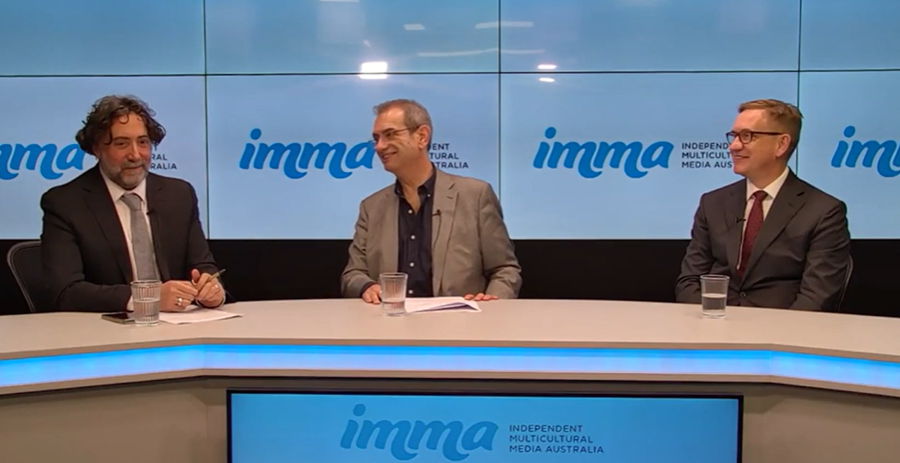
These questions formed the basis of an extended television interview with Assistant Minister for Multicultural Affairs, Citizenship and Customs Julian Hill, conducted by journalists Fotis Kapetopoulos and Marco Patavino for Independent Multicultural Media Australia (IMMA) and broadcast on Il Globo TV and Rete Theme. Hill discusses the rise of One Nation, the government’s response to the Multicultural Framework Review, skilled migration, Australia’s relationship with India, the Royal Commission into Antisemitism and Social Cohesion, organised crime and illicit tobacco, and whether Australia’s political centre can withstand growing pressure from ideological extremes.
Why established migrant communities are drifting towards One Nation
The rise of Pauline Hanson’s One Nation, to recently overtake the Coalition at the polls, has also shown some Greeks, Italians, Macedonians and others being seduced by One Nation, Hill was asked what his government was ding about it. Hill said the trend was largely a reflection many grievances and economic insecurity was the main one. a great
“People are under pressure,” he said.
“You look around the world, and we’ve had one crisis after another—COVID, global inflation, wars in Ukraine and the Middle East. Cost of living is the number one issue for Australians regardless of their cultural background.”
Populist parties he said identify “genuine public concerns” but offer no real or workable solutions.
“They point to things people are worried about, but they don’t have any real answers.”
Hill then took a hit on One Nation’s “parliamentary record”, and said Australians should look beyond social media clips.
“One Nation have voted against wages, against penalty rates, against paid parental leave. They’re no friend of working Australians.”
Multiculturalism remains Australia’s strength
Hill rejected Pauline Hanson’s One Nation narrative that Australia’s cultural and linguistic diversity is at the core of lack of civic cohesion and community division. That linguistic disvrety and access to transblators and intepreters as One Ntaion receltly artgued creaters divistuin.
“I love our country as it really is,” he said.
“We’ve been one of the most successful multicultural nations on Earth.”
Listing successive migrant communities, Greeks, Italians, Macedonian, Vietnamese, Chinese, Indians Hill said, “Australia has always evolved through migration.”
“The question isn’t whether we’ll be multicultural. We’ve always been multicultural. The question is whether our diversity remains a source of national strength or whether extremists exploit it to divide us.”
The missing piece: Australia’s multicultural framework
Kapetopoulos asked why the Multicultural Framework Review, chaired by Dr Hass Dellal AO, which a sharpened vision and new plan for the government and the prime minister to augment cohesion, support multiculturalism under a unifying national banner had not been fully implemented.
The review speaks also to notions of patriotic multiculturalism, or the importance of citizenship, residency and tax, underscores all Australians first and foremost.
While not directly responding as to why prime minster has not lifted or raised ;publicly a policy stamen or vision – now when needed most he said
“The Prime Minister’s been talking about this at length repeatedly, progressive patriotism, being proud of Australia, loving Australia, and committing to Australia,” Hill said.
He said that the Review “captured something fundamental.”
“Overwhelmingly Australians are proud Australians,” he said.
He said the Greek and Italian migrants for example, like all other migrants “came here wanting a better life for their children.”
“They worked hard, paid taxes, built businesses and today their children contribute across every profession.”
Hill then said, multiculturalism also requires obligations.
“When people come here they sign up to Australia’s laws, democracy, institutions and values—including equality between men and women and mutual respect.”
Hill endorsed the Prime Minister’s language of “progressive patriotism.”
“Multiculturalism isn’t only about rights. It’s also about responsibilities.”
Importantly, he distinguished integration from assimilation.
“We expect people to integrate—not assimilate. Australians shouldn’t have to leave their ancestral cultures at the door.”
Australian values not assimilation
The minister said come to Australia with “optimism” and “want a better life for their children through education.”
When again asked w
Hill said that “half” his family is of Italian heritage, “I grew up with the Greeks, deeply familiar, I grew up in Melbourne, how could you not?”
“People work hard, they pay taxes, they work multiple jobs, they help build the country and their kids now take their place in every part of Australian society.”
If multiculturalism is rights and responsibilities, what exactly is the Opposition talking about when it refers to ‘Australian values’?”
Hill
Hill argued Australia’s values are already clearly articulated.
“We have an Australian Values Statement. Every immigrant signs up to those values.”
He accused sections of the Opposition of attempting to outflank One Nation rather than defending mainstream liberal democratic values.
“You can’t out-One Nation One Nation.”
Instead, Hill argued Australia’s success depended upon remaining confident in both multiculturalism and national identity.
“I’m not afraid of the word integrate.”
Skilled migration remains essential
Marco Patavino shifted the discussion towards Australia’s ageing population and workforce shortages.
Many migrant communities, he noted, are themselves ageing and increasingly require bilingual aged care workers, health professionals and interpreters.
Hill agreed.
“As people age, many lose their second language and return to the language they first learnt as children.”
That reality, he said, reinforced the importance of professional interpreting services across hospitals, courts and government.
“It literally saves lives.”
On migration more broadly, Hill said Australia’s skilled migration program remained central to economic planning.
“We have an ageing population.”
“We need skilled migrants in aged care, education, construction and other sectors experiencing shortages.”
However, he emphasised that Australians must continue receiving first opportunity for employment.
“We’ve got to walk and chew gum.”
“We should train Australians first, but where genuine shortages exist, skilled migration is essential.”
Hill pointed to faster recognition of overseas qualifications, particularly for construction workers helping address Australia’s housing shortage.
Modi’s visit and multicultural confidence
Kapetopoulos raised Prime Minister Narendra Modi’s visit to Melbourne, where tens of thousands of Indian Australians packed Marvel Stadium in an unprecedented diaspora event.
The celebration was accompanied by protests from sections of Australia’s Indian community.
It was asked how ill felta out Midi not talng to any Indian or other media as a lkeacder of a democratic nation. And whether Should dissenting voices have been given greater prominence?
Hill welcomed democratic disagreement.
“Different views are a healthy thing.”
At the same time, he stressed India’s importance.
“India is the world’s largest democracy, the world’s largest country by population and one of Australia’s most important strategic and economic partners.”
He said welcoming foreign leaders while allowing peaceful protest reflected Australia’s democratic maturity.
Cost of living sits behind political anxiety
Throughout the interview Hill returned to the cost-of-living crisis.
Whether discussing One Nation or broader political dissatisfaction, he argued economic pressures remained the underlying driver.
He pointed to tax cuts, Medicare investment, cheaper medicines and energy reforms as measures intended to reduce financial stress.
“When governments govern well and deal with people’s concerns, there’s less opportunity for populists to exploit frustration.”
Antisemitism, extremism and whether the centre can hold
The most searching part of the interview centred on Australia’s sharp rise in antisemitism following the conflict in the Middle East.
Kapetopoulos framed the issue historically.
“For the first time, certainly in living memory—and arguably for well over a century—we’re seeing levels of antisemitism that many Australians never imagined possible.”
“Partly this has been fuelled by the Middle East conflict. But regardless of overseas conflicts, many Jewish Australians have said that for the first time in their lives they no longer feel entirely safe in Australia.”
“We’ve also witnessed extremism emerging from both the far right and parts of the activist left, often under the language of social justice. We now have a Royal Commission into Antisemitism and Social Cohesion.”
“Why has Australia reached this point? Is this simply the spillover of overseas conflict or are we witnessing a broader breakdown in social cohesion? And ultimately, will the political centre hold?”
Hill described the question as one of the defining issues facing Australian democracy.
“Whether the centre holds is perhaps the most important question facing Australian politics and society.”
He acknowledged Australia was experiencing many of the same pressures affecting democracies across Europe and North America but argued Australia’s institutions remained comparatively resilient.
“We’ve got compulsory voting. We’ve got an independent electoral commission. Those things have helped protect Australian democracy.”
Nevertheless, he warned Australia was not immune from growing ideological polarisation.
“We have the extreme right represented by One Nation and elements of conservative politics. We also have parts of the far left. But most Australians live in the centre.”
Hill rejected any suggestion that multiculturalism itself had produced these tensions.
“Polarisation and extremism don’t stem from diversity.”
“They stem from social distance, misinformation and malign authoritarian foreign governments seeking to interfere in democratic societies.”
Without pre-empting the Royal Commission, Hill drew a clear distinction between overseas governments and Australian citizens.
“Jewish Australians have been part of Australia since the earliest years of European settlement.”
“They have made extraordinary contributions to this country.”
“Australians, whatever their ethnic or cultural heritage, should never be held responsible for the actions of foreign governments.”
Hill said the government remained committed to confronting antisemitism with the same determination applied to Islamophobia and every other form of racism directed at multicultural communities.
Fighting organised crime
Patavino concluded by asking about organised crime and Australia’s illicit tobacco market.
Speaking as Assistant Minister for Customs, Hill described international criminal syndicates as sophisticated global businesses.
“They don’t care whether they’re smuggling tobacco, drugs, firearms or counterfeit goods.”
He said record seizures at Australia’s borders reflected increased enforcement while warning that organised crime required coordinated international responses.
“The best shipment of illegal tobacco is the one that never reaches Australia.”
Australia’s next chapter
Across the interview one message remained remarkably consistent.
Hill believes Australia’s multicultural settlement has not failed—it has succeeded beyond expectations.
But success cannot be taken for granted.
Economic insecurity, misinformation, geopolitical conflict and political extremism are placing new pressures on social cohesion.
His answer is neither assimilation nor identity politics.
Instead, he argues for a confident multiculturalism built upon Australian citizenship, democratic institutions, shared civic values and mutual responsibility.
For Hill, Australia’s future depends less on where Australians came from than on whether they continue believing they belong to one national community.
“The centre can hold,” he suggested.
“But only if Australians continue choosing unity over grievance, integration over division, and confidence over fear.”





Interesting perspective on migration and multiculturalism in Australia. What do you think the biggest challenges are for newcomers?