What Nepal’s Devastating Flash Floods Ask of Us

 By Dr Nabaraj Mudwari
By Dr Nabaraj Mudwari
“Have you heard from Mum and Dad yet?”
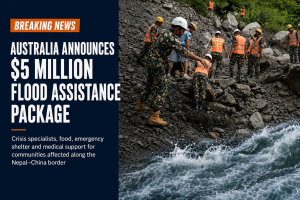
It is a question many Nepalese Australians have been asking in recent days. As devastating flash floods swept through Nepal’s Rasuwa, Nuwakot and Dhading districts, people across Australia found themselves glued to their phones, desperately trying to contact parents, siblings and relatives in affected communities. Some received reassuring news. Others received heartbreaking news. Many are still waiting.
Australia is home to almost 200,000 Nepal-born residents, many of whom maintain close ties with family and friends in Nepal. When disaster strikes there, the impact is felt here as well.
Across Nepal, families are mourning loved ones, searching for missing relatives and facing the enormous task of rebuilding their lives. The immediate priority is clear: rescue, relief and recovery.
But beyond the humanitarian response lies a deeper question:
What responsibilities do we have to one another when disaster strikes?
In times of crisis, we naturally focus on the scale of destruction. We count casualties, damaged homes and economic losses. These numbers matter. They help us understand the magnitude of the tragedy.
Yet disasters reveal more than damaged infrastructure. They reveal our humanity. They show whether we merely witness suffering or respond to it.
Compassion Requires Action
Compassion is often confused with sympathy.
Sympathy recognises suffering.
Compassion responds to it.
When tragedy occurs, many of us post messages of support, share news stories or offer prayers. These gestures have value. They remind people that they are not alone.
But compassion asks something more:
- What can I do to help?
- Who needs my support?
- How can I turn concern into action?
The true test of compassion is not what we feel. It is what we do.
Why This Matters in Australia
Australia and Nepal share a relationship built on more than six decades of diplomatic ties and strong people-to-people connections. Australians have long been drawn to Nepal’s mountains, culture and hospitality. Nepalese Australians, in turn, have contributed enormously to Australian society through their work, study, business and community leadership.
Today, many Nepalese Australians, international students and temporary visa holders have family members directly affected by the floods. For them, this is not simply an overseas disaster. It is personal.
Some are coping with grief. Others are worrying about relatives who have lost homes, livelihoods or community support networks. Many are struggling with the painful reality that they cannot immediately be with their loved ones.
Their experience reminds us that disasters do not stop at national borders. The floodwaters may be in Nepal, but the emotional impact reaches homes, workplaces, classrooms and communities throughout Australia.
How Australians Can Help
The first response should be simple: reach out.
A phone call, a conversation or a message of support can make a meaningful difference to someone carrying the stress of uncertainty and loss.
Practical support matters too. Australians can contribute to trusted humanitarian appeals and community fundraising initiatives supporting affected families. Every contribution, no matter how small, can help affected communities meet immediate needs and begin the long process of recovery.
Universities, employers and community organisations can also demonstrate compassion through flexibility and understanding for people dealing with family emergencies, grief and financial pressures.
Often, the most meaningful support comes through small acts of kindness.
A Role for Government
Australia has a long history of supporting countries affected by natural disasters, including Nepal. The two countries share more than six decades of diplomatic relations and strong people-to-people ties. Any humanitarian assistance or recovery support will be greatly appreciated.
Australia can also support those affected here at home. Urgent travel arrangements for people needing to visit severely affected family members could provide much-needed relief. Working with organisations such as NRNA Australia would help identify community needs and coordinate support more effectively.
These are practical steps. But they are also acts of compassion.
Beyond Recovery
In time, the floodwaters will recede.
Roads will be rebuilt. Homes will be reconstructed. Communities will recover.
The real question is what we do between now and then.
Will we move on once the headlines fade?
Or will we stand alongside those affected as they rebuild their lives?
Future generations may not remember every statistic from this disaster. But they will remember how people responded. They will remember whether compassion was simply expressed or genuinely practised.
At moments like this, the challenge is not merely to appear caring.
The challenge is to be caring.
And perhaps that is the most important lesson this tragedy asks us to learn.
Dr Nabaraj Mudwari is an educator, researcher and author with an MPhil in Development Studies and a PhD in Education. He currently works in the Australian education sector and has over 20 years of experience in teaching and educational leadership. His writing explores themes of education, society and spirituality.
Email: nabaraj.mudwari@utas.edu.au